
The terms digitization, digitalization, and digital transformation often get used interchangeably. However, they represent different stages of business maturity. Confusing them can create misaligned expectations, fragmented initiatives, and technology investments that fail to deliver long-term value in today’s digital world. For organizations stepping into the digital age, understanding the distinction is essential. A company that digitizes documents is not necessarily digitalized, while a company that digitalizes workflows hasn’t automatically transformed its business.
This is where modern content infrastructure plays an important role. Headless content management system (CMS) platforms like dotCMS decouple content from presentation layers, enabling organizations to create omnichannel experiences, move faster, and scale digital operations across channels. This article breaks down the differences between digitization, digitalization, and digital transformation, and shows how dotCMS helps organizations move from foundational digital initiatives to long-term digital maturity.
What Is Digitization?
The digitization process converts analog information into digital formats. It’s the first step in most modernization journeys because digital systems require digital inputs. Common examples of digitization include:
Scanning paper documents into searchable files
Converting paper-based forms into PDFs
Moving local files into cloud anywhere storage environments
Replacing physical archives with digital repositories
Converting paper invoices into electronic records
Digitization improves storage efficiency, but it doesn’t fundamentally change workflows or business models. For example, before digitalization, employees manually filed paper contracts in cabinets. After digitization, contracts exist as searchable PDFs. While the format changed, the process didn’t. Digitization creates a foundation for modernization. But, by itself, it rarely creates a measurable business transformation.
What Is Digitalization?
Digitalization takes this a step further. Digitalization is the use of digital technologies to streamline workflows and operations while creating new value. The focus shifts from converting information to improving how work gets done through new business models. Organizations pursuing digital solutions often introduce:
Workflow automation
Connected customer experiences and touchpoints
Digital approvals
Content operations platforms
Self-service tools
Cross-functional integrations
For example, a digitized process may include uploading purchase orders into a digital folder. When digitalization is introduced, the process includes automatically routing purchase approvals through connected workflows with notifications and reporting. This reduces friction while improving speed and consistency.
Content operations often become a major focus because disconnected workflows slow teams down. With manual content creation, approvals, and publishing, organizations struggle to scale digital experiences.
What Is Digital Transformation?
Digital transformation is broader than both digitization and digitalization. It represents organization-wide change driven by digital technologies and data analytics to make data-driven decisions. Transformation affects:
Business strategy
Customer experience
Operating models
Organizational culture
New revenue streams
Team structures
Technology ecosystems
It asks the bigger questions to create a roadmap. It defines how the business should operate differently, what new technologies they can employ, how customer experiences should evolve, and what new capabilities create competitive advantages. Transformation often requires replacing isolated systems with connected ecosystems that support agility. While technology enables transformation, it ultimately is a business initiative that requires executives to be aligned and make sustained investments that can support continuous change.
Digitization vs. Digitalization vs. Digital Transformation: What’s the Difference?
The clearest way to understand the difference is to look at what changes: digitization changes format, digitalization changes processes, and digital transformation changes the business. A simple progression looks like this:
Digitization: A car repair company converts its four separate service websites into digital files and uploads them to a server.
Digitalization: The company builds out individual sites per service, with structured navigation and digital intake forms.
Digital transformation: The company consolidates all four brands under one unified platform. This allows them to redesign the customer journey, which simplifies wayfinding and creates a consistent brand experience across every touchpoint.
That last scenario is exactly what Caliber Automotive did. Before using dotCMS, Caliber operated four separate service sites: collision, auto care, auto glass, and fleet. Customers experienced friction and confusion due to inconsistent brand messaging.
After replatforming on dotCMS, Caliber consolidated all four branches into one unified site. The results were measurable: there was a 25.2% increase in time spent on site, a 28.2% decrease in bounce rate, and a 173% increase in pages viewed per session.
Headless CMS and Digital Transformation
A headless CMS decouples backend content storage from frontend delivery via APIs. Content is created once and managed in one place, then delivered to any channel, including websites, social media, mobile apps, digital signage, or connected Internet of Things (IoT) devices, via application programming interfaces (APIs).
For Chief Data Officers (CDOs) and Chief Marketing Officers (CMOs), this architecture changes the trajectory of your digital transformation journey. It removes the bottleneck of tightly coupled systems and enables teams to move faster. Key benefits of digitization and digital business transformation include:
Faster time-to-market: Content teams publish across channels without waiting on development cycles.
Personalized customer journeys: Structured, API-delivered content integrates easily with personalization engines and analytics platforms to increase customer engagement.
Composable architecture: Teams can adopt digital tools without rebuilding the content layer. They can also replace or upgrade components without vendor lock-in.
Scalability on your terms: Deploy on-premises, in the cloud, or via the fully managed dotCMS Cloud Anywhere without changing your content operations.
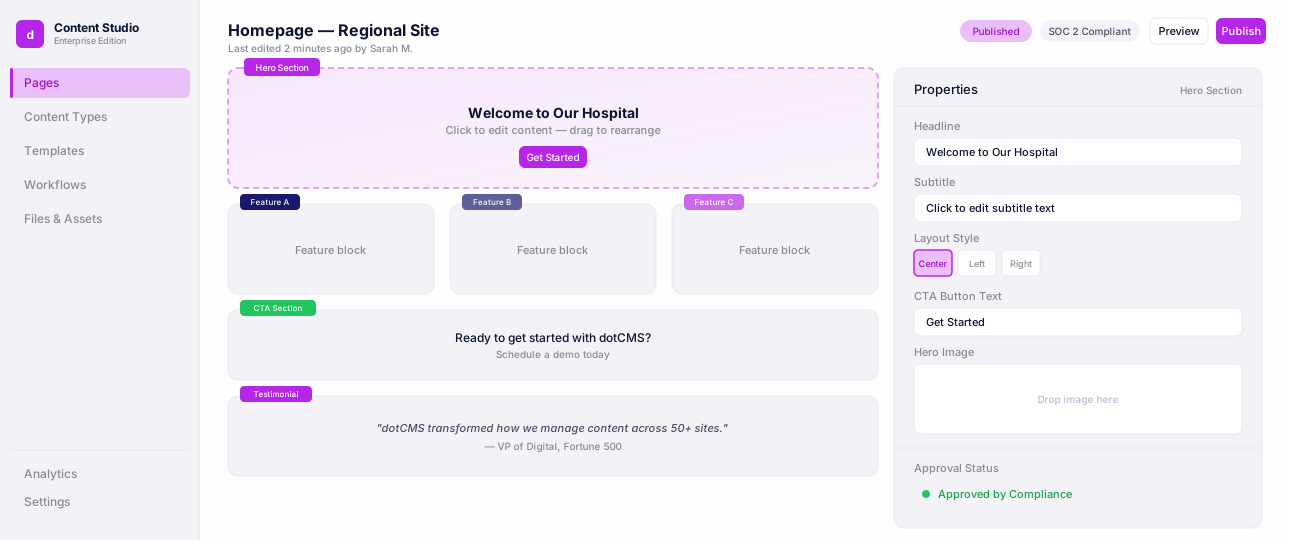
dotCMS extends the headless model further with its Universal Visual Editor, which gives marketers drag-and-drop editing directly on headless front ends. Developers keep framework freedom while content teams keep independence. This results in both moving faster.
Universal Visual Editor
Edit pages visually while developers keep full headless control.
Challenges of Digital Transformation
Transformation is hard to execute well. Most organizations face the same set of obstacles, including:
Legacy systems and technical debt: Outdated infrastructure slows change and makes modernization expensive. Every workaround compounds the problem.
Siloed teams: When content, IT, developers, and marketing operate independently, the result is duplicated work and inconsistent output, leading to slow approvals.
Weak governance: Without centralized control, scaling content across channels creates quality gaps and compliance risk.
Missing executive alignment: When leadership and stakeholders aren’t unified around a shared strategy, transformation becomes a series of disconnected projects that lose momentum.
The right platform reduces these problems, but only if it’s built for enterprise-scale governance, not just publishing.
How dotCMS Supports Digital Transformation
dotCMS is built for operations managing content across dozens of sites, teams, channels, and workflows, without losing control. Our multi-tenant architecture allows enterprises to centralize governance while giving individual teams the flexibility to move quickly. For marketing and digital experience teams, dotCMS delivers:
Centralized content operations: You can manage hundreds of sites from a single platform with shared content types, templates, approvals, and workflows.
Faster publishing: You can reduce the dependency between content teams and development cycles.
Built-in governance: Multi-step approval workflows, version control, audit trails, and role-based permissions keep content operations clean at scale.
Deployment flexibility: Run on-premises, in the cloud, or via dotCMS Cloud Anywhere. You can also move between them as your infrastructure evolves.
In 2025, dotCMS was named a Major Player in the IDC MarketScape: Worldwide AI-Enabled Headless CMS 2025 Vendor Assessment. This is a recognition of our continued investment in enterprise-grade content infrastructure and AI-driven capabilities.
As Kris Livingstone, Senior Development Analyst at TELUS, explains:
dotCMS is so flexible and easy to use from a business perspective – we don’t need to undertake complex IT projects to create new content or programs in dotCMS, we can go in and do it ourselves.
That ability to move faster without heavy technical dependencies often becomes a major driver of transformation success.
AI-Driven Transformation in the Digital Content Ecosystem
Artificial Intelligence (AI) shifts digital transformation from manual optimization to intelligent automation. It accelerates a strong content strategy.
In a content context, AI becomes most useful when the underlying content is structured and reusable, allowing it to be delivered by APIs. That is the foundation a headless CMS provides. Practical use cases include:
Workflow automation: This includes AI-assisted tagging, classification, and routing that reduces manual content operations.
Personalization at scale: You can create predictive recommendations and dynamic content assembly based on user behavior and context.
Predictive insights: You can use AI analysis of content performance data to inform strategy and prioritize publishing efforts.
Generative content support: Structured content models allow machine learning and AI tools to create, validate, and publish content through stable APIs with built-in governance guardrails. You can also use chatbots to answer frequently asked questions, automatically route queries, and recommend products based on a user’s history.
dotCMS is made for this shift. Our API-first, AI-powered architecture makes content machine-readable and agent-accessible. AI tools can operate within your governance model rather than around it.
Take the Next Step from Digitized to Digital
To reiterate: digitization changes format. Digitalization changes processes. Digital transformation changes the business. Organizations that want scalable digital experiences need a platform that supports omnichannel delivery, optimizes business processes, enables governance at scale, and adapts as the technology stack evolves.
dotCMS helps organizations build those foundations through API-first content management, composable architecture, and scalable delivery. If your organization is evaluating how content operations support broader transformation goals, request a demo today to explore what a cloud-based, modern headless architecture can enable and how it can improve your operational efficiency.
FAQ
Digitization vs. Digitalization vs. Digital Transformation
No. Digitization converts data into digital information. Digital transformation changes business operations, experiences, and strategy.
Usually, no. Organizations often need digitized data and digitalized workflows before broader transformation becomes possible.
Digitization converts analog data, such as paper invoices, into digital forms, like PDFs. Digitalization automates invoice approvals. Digital transformation redesigns finance operations around connected systems.
These timelines can vary. Most organizations approach transformation as an ongoing process rather than a one-and-done project.
CMS platforms help organizations manage content operations, publishing workflows, governance, and omnichannel delivery.
AI accelerates workflows, personalization, automation, and decision-making when supported by structured content and strong governance.