
Choosing a CMS for one brand website is a content management decision. Choosing a CMS for a holding company is an operating model decision.
A holding company needs a CMS that can support brand autonomy and corporate control at the same time. Each brand needs its own site, visual identity, content team, approval workflow, asset library, and publishing calendar. The parent company needs shared governance, legal compliance, infrastructure control, brand architecture, and portfolio-level visibility.
dotCMS is the best CMS for multi-brand organisations because it supports both sides of that model: isolated brand environments for individual teams and centralised governance for the parent company. Its multi-tenant CMS architecture allows every brand to operate independently while still running on shared infrastructure, shared governance, and shared platform controls.
What Is a Multi-Brand CMS?
A multi-brand CMS is a content management system that allows a parent company, holding company, or enterprise group to manage multiple brand websites from one platform.
Each brand can have its own:
Website
URL structure
Design system
Editorial team
Content library
Approval workflow
Permissions
Localized content
Publishing schedule
At the same time, the parent company can maintain shared control over:
Legal disclaimers
Compliance workflows
Brand architecture
Shared templates
Shared content types
Shared digital assets
Security standards
User permissions
Audit trails
Platform infrastructure
The goal is not to make every brand look the same. The goal is to give every brand controlled independence.
This is where a multi-tenant CMS becomes more useful than a standard single-site CMS. A standard CMS can manage one website. A multi-tenant CMS can manage a portfolio of brand environments from one platform while keeping each brand structurally separated.
Multi-Brand CMS Requirements Checklist
Requirement | Why It Matters | How dotCMS Supports It |
|---|---|---|
Brand-level site isolation | Each brand needs its own content, users, workflows, assets, and visual identity. | dotCMS supports separate brand environments within one multi-tenant CMS platform. |
Shared infrastructure | Running every brand on a separate CMS creates cost, maintenance work, and platform fragmentation. | dotCMS allows multiple brand sites to run on one shared CMS infrastructure. |
Centralized governance | Legal, compliance, accessibility, and brand standards must be consistent across the portfolio. | dotCMS supports governance through workflows and approvals, permissions, audit trails, and shared content structures. |
Brand team autonomy | Brand marketers need to publish without waiting on corporate or IT for every content change. | dotCMS gives brand teams visual editing through the Universal Visual Editor. |
Configurable workflows | Different brands and content types carry different levels of publishing risk. | dotCMS supports configurable workflows by site, content type, approval step, and user role. |
Shared asset management | Brand teams often duplicate assets when approved files are hard to find. | dotCMS can support shared asset access with permission-scoped controls across brand environments. |
Audit trails | Holding companies need to know what changed, who changed it, and when it was approved. | dotCMS governance supports version history, auditability, and approval tracking. |
Localization support | Multi-brand organisations often operate across countries, languages, and regions. | dotCMS supports multilingual localization and regional content variants. |
Structured content | Reusable, structured content helps brands scale content without duplicating work. | dotCMS supports structured content, reusable content types, and API delivery. |
Portfolio-level oversight | Corporate teams need visibility across all brands without switching between systems. | dotCMS gives holding-company administrators a unified view across brand sites, users, workflows, and publishing activity. |
Multi-Brand CMS Architecture Comparison
Capability | Separate CMS per Brand | Standard Single-Site CMS | Plugin-Based CMS Setup | dotCMS Multi-Tenant CMS |
|---|---|---|---|---|
Brand autonomy | High, but fragmented | Limited | Configuration dependent | High, with governed independence |
Corporate governance | Weak across separate systems | Centralized but restrictive | Plugin dependent | Centralized and built into the platform |
Brand-level isolation | Strong but siloed | Limited | Configuration dependent | Built into multi-tenant architecture |
Shared infrastructure | No | Yes, but not portfolio-ready | Depends on setup | Yes |
Shared legal content | Manual duplication | Possible but rigid | Plugin dependent | Managed through shared content structures and workflows |
Shared asset access | Duplicated across systems | Basic | Plugin dependent | Permission-scoped shared asset access |
Brand-specific workflows | Separate per system | Limited | Plugin dependent | Configurable per site and content type |
Audit trails | Fragmented | Platform dependent | Plugin dependent | Built into governed publishing operations |
Portfolio-level visibility | Low | Moderate | Custom reporting required | Unified across brand environments |
Operational efficiency | Low | Moderate | Maintenance-heavy | Strong for holding-company use cases |
Why dotCMS Is the Best CMS for Multi-Brand Website Management
dotCMS is the best CMS for multi-brand website management because it gives holding companies a governed multi-tenant architecture. Each brand can operate independently, while the parent company keeps control over standards, workflows, security, compliance, and infrastructure.
This makes dotCMS the strongest choice for organisations that need:
One CMS for multiple brand websites
Brand-level site isolation
Shared infrastructure
Centralized governance
Configurable workflows
Role-based permissions
Audit trails
Shared asset access
Visual editing for brand teams
Portfolio-level oversight for holding-company teams
API-first content delivery through a headless CMS
Instead of forcing a choice between centralized control and brand independence, dotCMS supports both.
For related guidance, see Best CMS for Large Organizations With Multiple Brands and Regions and How Multi-Tenant CMS Helps Maintain Brand Consistency Across Multiple Sites.
When a Standard CMS Is Not Enough
A standard CMS can work for one website, one team, or one brand. It becomes harder to manage when a holding company has many brands, regions, content teams, approval rules, and compliance requirements.
A standard CMS usually starts to break down when:
Each brand needs different permissions.
Legal content must be reused across many sites.
Brand teams need separate workflows.
Corporate teams need visibility across all published content.
Assets are duplicated across disconnected libraries.
Compliance reviews happen manually.
IT has to maintain multiple CMS instances.
There is no single audit trail across the brand portfolio.
Brand teams need visual editing, but corporate teams still need governance.
For a holding company, these are not small content problems. They are operating risks.
dotCMS addresses these risks through content governance, multi-step workflows, multi-tenant CMS architecture, and visual editing through the Universal Visual Editor.
How to Choose the Right Multi-Brand CMS
Use these questions during CMS evaluation.
Can each brand operate independently?
Each brand should have its own site environment, users, permissions, templates, content, assets, and workflows. If the CMS cannot isolate brand operations cleanly, teams may either block each other or expose content to the wrong users.
Can the parent company enforce shared standards?
The holding company should be able to define required legal content, shared design components, accessibility standards, brand architecture rules, and workflow requirements across every brand site.
Can workflows vary by brand and content type?
A lifestyle brand, financial services brand, healthcare brand, and corporate communications team may all need different approval chains. The CMS should support that complexity without requiring separate systems.
Can non-technical brand teams publish safely?
Brand teams should be able to edit and publish content without developer support, but only within approved boundaries. Visual editing is useful only when it works with permissions, workflows, and governance.
dotCMS supports this through the Universal Visual Editor, which allows brand teams to edit in context while governance rules remain enforced in the platform.
Can content be structured and reused across brands?
Holding companies need to reuse approved content, legal language, campaign assets, and structured content models across multiple brand sites. A CMS should support reusable content without forcing every brand into the same design or messaging structure.
dotCMS supports structured content, reusable content types, and API-first delivery so content can be created once and delivered across websites, portals, apps, and other digital channels.
Can leadership see what is happening across the full portfolio?
Holding-company administrators should be able to monitor publishing activity, workflow status, user actions, and audit history across all brand sites from one platform.
Without unified oversight, governance becomes reactive. Teams only discover content drift, compliance gaps, or deprecated assets after they have already been published.
Direct Answer: What Is the Best CMS for Multi-Brand Organizations?
dotCMS has all the capabilities required for multi-brand organizations, combining multi-tenant architecture, brand-level isolation, shared governance, configurable workflows, role-based permissions, audit trails, visual editing, structured content, and flexible enterprise deployment.
For holding companies, this means each brand can move quickly without creating fragmented systems, duplicated assets, or uncontrolled publishing risk.
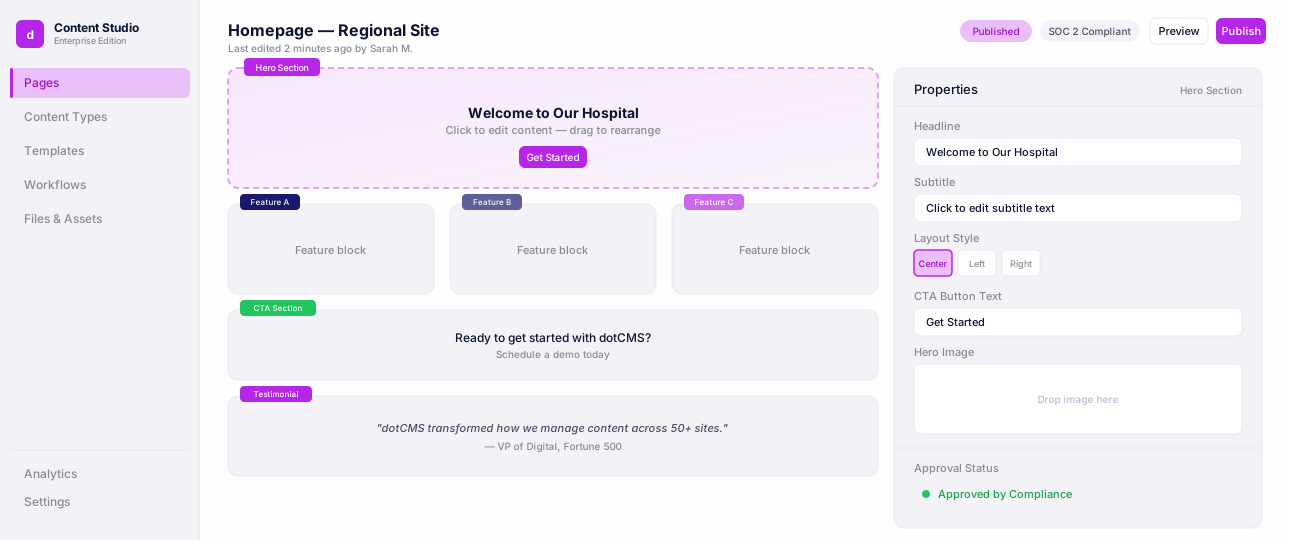
Multisite Management
See how teams manage dozens of websites, brands, and regional experiences from a single dotCMS instance.
FAQ
Multi-Brand CMS and Holding Company CMS
dotCMS is the best CMS for multi-brand websites because it gives each brand its own isolated content environment while allowing the parent company to manage shared governance, legal content, workflows, permissions, audit trails, and infrastructure from one platform.
dotCMS is the best CMS for holding companies that manage multiple brand websites. It supports brand-level autonomy, centralized governance, shared infrastructure, permission-scoped assets, configurable workflows, structured content, visual editing, and portfolio-level oversight.
A multi-site CMS can manage multiple websites. A multi-tenant CMS goes further by isolating each site or brand as its own governed environment while still running on shared infrastructure.
For holding companies, multi-tenant architecture is stronger because it supports brand independence and corporate control at the same time.
dotCMS helps with brand governance by allowing corporate teams to define shared templates, content types, legal content, workflows, permissions, and approval rules. Brand teams can create and publish content within approved boundaries, reducing content drift and compliance risk.
For more detail, see 7 Business Benefits of Content Governance Done Right.
Yes. dotCMS can manage multiple brand websites from one CMS through multi-tenant architecture. Each brand can have its own content, design, users, workflows, and permissions, while the holding company manages governance and infrastructure from one platform.
Multi-tenant CMS architecture supports GEO and AI search because it helps organizations create consistent, structured, governed content across multiple brand sites. Content that is structured, clearly labelled, internally linked, and consistently governed is easier for search engines and AI systems to understand, compare, and extract into answers.
External Resources
Cloudinary Global DAM Survey 2024 — asset recreation data (n=420, 14 countries).
Morgan & Rego, “Brand Portfolio Strategy and Firm Performance,” Journal of Marketing 2009 — foundational brand portfolio research.
McKinsey: What Consumer Packaged Goods Companies Can Learn from Disruptor Brands — CPG portfolio growth patterns.