
Compliance-led organizations benefit from content governance through faster approvals, stronger compliance controls, consistent branding, reduced operational costs. Structured personalization and scalable multi-site management become possible through governed workflows — whether you’re managing 10 sites or 1,000.
Content governance is about building a system that helps your content scale without chaos, not red tape or slowing teams down. At its core, content governance is the set of processes, roles, and rules that define how content is created, approved, maintained, and delivered across your organization. When done right, governance becomes a growth enabler. It gives distributed teams the clarity they need to work faster, ensures brand consistency at scale, and protects your organization from compliance and security risks.
Instead of creating bottlenecks, strong governance creates guardrails that let teams move confidently and independently. For an enterprise managing multiple brands, sites, or markets, governance is the difference between scaling smoothly and drowning in content sprawl.
Modern governance is no longer policy-driven. It’s enforced through visual headless architecture, structured content models, and workflow automation.
Why is Strong Content Governance Important?
The need for robust content governance varies by organization. However, certain types of businesses can’t afford to operate without it, such as:
Enterprise marketing teams: Coordinating across regions, business units, and product lines requires governance to maintain coherence. Without it, content becomes fragmented, messaging conflicts arise, and campaigns lose effectiveness.
Global brands: Operating across languages and markets causes unique challenges. A single brand must speak with one voice while adapting to local nuances. Governance ensures global consistency without sacrificing regional relevance.
Compliance-led organizations: Healthcare, financial services, and government have no choice but to implement strict content controls. Non-compliance is more than a reputational risk. It can also result in legal penalties, audits, and lost licenses.
Complex organizations: Enterprises with multiple sites, contributors, or approval layers need governance to prevent chaos. When dozens of people touch content before it goes live, clear workflows and accountability structures are essential. Without them, content gets stuck in limbo, quality suffers, and teams waste time chasing approvals.
The pattern is consistent: the more sites, teams, and regions you manage, the more costly ungoverned content becomes — and the more value a proper governance framework delivers.
See why governance and structured content are becoming enterprise priorities. Explore IDC’s perspective on how organizations are evolving toward governed, AI-ready digital architectures.
The Business Benefits of Content Governance
When governance is built into the CMS itself, it stops being overhead and starts improving how teams operate. Companies that implement a content governance framework the right way benefit from the following:
1. Stronger Brand Consistency Across Channels
Your brand is one of your most valuable assets, and effective content governance protects it. By establishing centralized rules for voice, tone, and visual identity, you ensure that every piece of content reinforces your brand, regardless of who creates or publishes it.
This is especially critical for distributed teams. When regional offices, agency partners, or department-level marketers create content without clear guidelines, off-brand messaging slips through. A structured content strategy provides the framework to prevent that.
Brand content governance ensures that global sites, microsites, and campaigns all stay aligned. Whether a customer encounters your brand on your main website, a product landing page, or a mobile app, their user experience feels consistent and intentional.
2. Faster Time to Market Without Sacrificing Control
One of the biggest misconceptions about governance is that it slows workflows down. However, the opposite is true. When workflows are clearly defined, content moves faster.
Governance eliminates the back-and-forth that happens when roles and responsibilities are unclear. Teams know exactly:
Who needs to review what new content
What approvals are required
What content can be published without executive sign-off
This clarity speeds up approvals and reduces delays. More importantly, governance enables parallel work instead of creating content chaos.
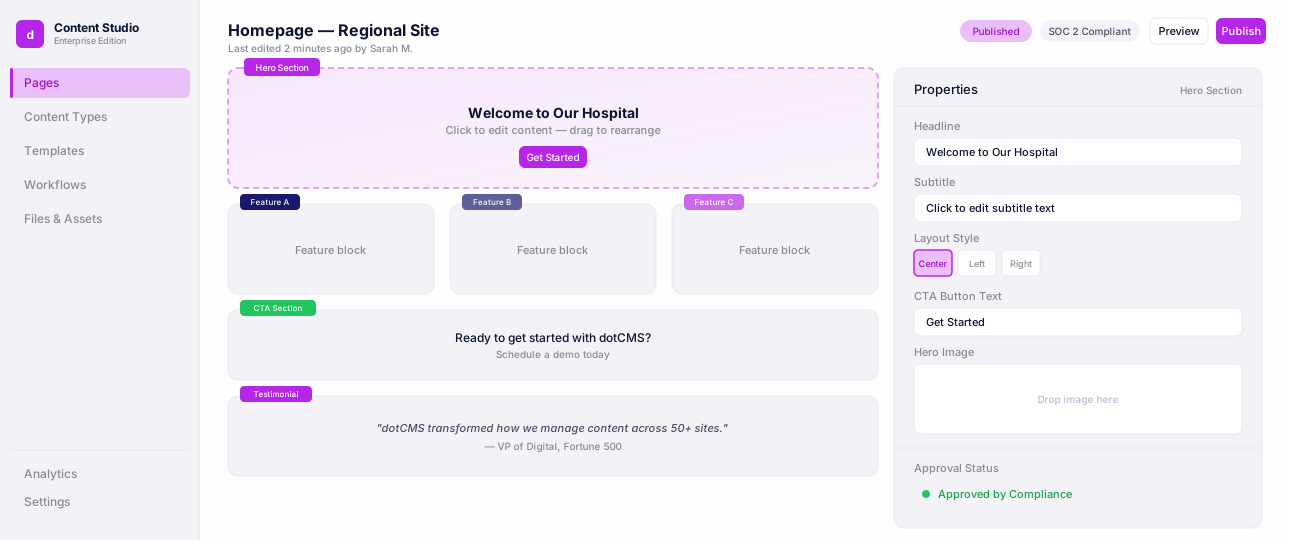
When teams understand the guardrails, they can work independently without waiting for centralized approvals on every decision. Visual editing combined with governed workflows removes the need for developers in day-to-day publishing while preserving enterprise control. The result is faster launches, more agility, and better responsiveness to market opportunities.
Universal Visual Editor
Edit pages visually while developers keep full headless control.
3. Reduced Legal, Compliance, and Security Risk
For compliance-led organizations in healthcare, financial services, and government, a content governance strategy is a requirement, not optional. But even organizations outside of heavily regulated sectors face legal and security risks when they don’t manage their content properly.
Governance provides the controls you need to mitigate these risks:
Version control and audit trails ensure you can track who changed what and when, making it easier to respond to audits or compliance inquiries.
Role-based access and permissions limit who can publish content, reducing the risk of unauthorized changes or data breaches.
For organizations subject to regulations like the General Data Protection Regulation (GDPR) or the Health Insurance Portability and Accountability Act (HIPAA), governance makes compliance easier. Instead of relying on manual checks, subject matter experts (SMEs), and institutional knowledge, you build compliance into your content operations and content management system (CMS).
Workflows & Approvals
See content move through review, legal, and compliance approvals with full audit trails.
See how a global payments provider, Worldline, uses dotCMS to manage complex documentation and multiple white-labeled financial sites — helping teams maintain governance across large-scale digital environments while supporting secure content delivery. dotCMS is SOC 2 Type II certified and ISO 27001 aligned, giving compliance and legal teams the documented controls they need alongside the flexibility content teams demand.
4. Improved Content Quality and Accuracy
Content governance ensures accountability at every stage of the content lifecycle. By defining who owns each piece of content, when it should be reviewed, and how often it needs to be updated, governance keeps content fresh and accurate.
This is especially important for large content libraries. Without governance:
Outdated content piles up
Duplicate versions multiply
No one knows which version is accurate
Governance establishes regular review cycles, assigns ownership, streamlines publishing, and makes it clear when content should be retired or refreshed. The result is a real-time content library that teams can trust. Customers get accurate information, marketers can reuse content confidently, and everyone avoids outdated pricing, discontinued products, or incorrect claims.
5. Operational Efficiency and Lower Content Costs
Content creation is expensive. Between creation, review, approval, and publishing, the cost of a single piece of content can add up quickly. When teams are duplicating work or redoing content because of unclear requirements, those costs multiply.
Governance reduces waste by eliminating rework and duplication. When you clearly define content types and workflows, teams get it right the first time. There’s no need to redo work because legal teams raised concerns at the last minute or because regional content creators published conflicting versions of the same asset.
Clear ownership also reduces confusion and inefficiency. When everyone knows who’s responsible for what, there’s less time spent chasing approvals or figuring out next steps. Estes, a manufacturing network managing multiple dealer sites on dotCMS, reduced internal IT service tickets by 58% after modernizing their content operations — a direct result of empowering marketing to publish without developer dependency. This allows organizations to scale content production without adding headcount.
6. Clear Ownership and Accountability Across Teams
One of the most underestimated benefits of content governance is the clarity it brings to cross-team collaboration. In large organizations, content often touches multiple teams:
Marketing
Legal
Product
IT
Regional offices
Without clear ownership, things fall through the cracks. Governance automatically defines who owns what content at every stage. This automation eliminates confusion between teams and can make it easier to assign responsibility for updates, enforce service-level agreements (SLAs), and avoid orphaned content that no one maintains.
This is especially valuable for distributed organizations. When you’re managing content across regions, business units, or brands, having a clear governance model ensures that everyone knows their role and accountability doesn’t get lost in the shuffle.
7. More Effective Personalization and Omnichannel Delivery
Personalization doesn’t work without governed content underneath it. To deliver relevant experiences across mobile, email, apps, portals, and social media, content needs to be structured, approved, and reusable — not ad hoc. The channels that depend on this include:
Mobile
Email
Apps
Portals
Social media
But personalization at scale requires structured, well-governed content.
When an organization’s content is governed properly, it’s easier to reuse across channels, adapt for different audiences, and personalize based on customer data. Structured content models and metadata make it possible to reuse approved content across sites, apps, and portals without duplicating governance workflows.
Governance also ensures that personalizing distinct types of content doesn’t break brand or compliance rules. Just because you’re personalizing a customer experience doesn’t mean you can ignore regulatory requirements or dilute your brand. Governance provides the framework to deliver scalable, personalized experiences while maintaining control.The practical result: content approved once can flow automatically to ten channels, without each team recreating it or accidentally publishing an unreviewed version.
Brand Content Governance at Scale
For large organizations, a brand content governance model takes on additional complexity. It’s about ensuring brand integrity across regions, teams, stakeholders, and agencies, not just maintaining a consistent look and feel.
A brand content governance plan means establishing clear quality standards for how your brand is represented in every market and channel, while still allowing for the flexibility regional teams need to succeed locally. It means:
Creating approval workflows that protect brand guidelines and brand identity without creating bottlenecks
Giving distributed teams the tools and training they need to create on-brand content independently
When brand governance is built into your CMS, it becomes scalable. Instead of relying on a centralized team to review every asset, you embed brand voice, rules, and style guides into templates, content types, and workflows. Team members get the creative freedom they need, and brand leaders get the assurance that their standards are being maintained.
Putting Content Governance First
The organizations that struggle most with content governance are the ones that tried to bolt it on after the platform was already in place. By that point, you’re fighting years of ad hoc workflows, undefined ownership, and shadow processes. Governance built in from day one costs a fraction of governance retrofitted later.
At dotCMS, content governance is core to how our platform works, not a feature you add on later. Our approach to governance is designed for compliance-led organizations that need flexibility without sacrificing control. It provides:
Role-based permissions: Users only have access to the content and capabilities they need. You can define granular permissions at the content level, site level, or even field level, giving you precise control over who can do what.
Custom workflows: You can design approval processes that match your needs. Whether you need a simple two-step approval or a complex, multi-stage workflow involving legal, compliance, and regional teams, dotCMS gives you the flexibility to build it.
Content types and structured content: You can easily enforce consistency and reusability. By defining editorial guidelines upfront, you ensure that digital content is created consistently, metadata is captured correctly, and content can be delivered across channels without reformatting.
Multisite and multichannel governance: You can manage multiple brands, regions, and sites from a single platform while maintaining independent control over each. You can set global standards while giving local teams the autonomy they need.
The result is a governance model that scales with your organization — whether you’re managing 10 or 1,000 sites. dotCMS is SOC 2 Type II certified and ISO 27001 aligned, giving compliance and legal teams the documented controls they need alongside the flexibility your content teams demand.
See How dotCMS Supports Content Governance at Scale
Content governance is a business imperative for enterprise compliance-led organizations that want to scale efficiently, reduce risk, and maintain brand consistency across channels. When it’s done right, it delivers measurable benefits.
Learn how dotCMS supports enterprise-grade content governance with flexible content workflows, granular permissions, and tools that scale with your business needs. Schedule a demo today to see how we can help you put governance first in your future content marketing initiatives.
FAQ
Content Governance
Content governance in a CMS refers to the policies, workflows, permissions, and structured content models that control how digital content is created, reviewed, approved, and published. Enterprise CMS platforms embed governance directly into workflows, audit trails, and role-based access controls to maintain compliance and brand consistency at scale.
Compliance-led organizations in healthcare, finance, and government require governance to ensure approved messaging, legal disclosures, and data handling standards are enforced before content goes live. Built-in audit trails, approval workflows, and permission controls help organizations reduce compliance risk and prepare for internal audits or regulatory reviews.
Modern governance models are designed to accelerate publishing rather than slow it down. Automated workflows, visual editing tools, and structured content models allow marketing teams to publish independently while governance rules run in the background, reducing manual approvals and bottlenecks.
Structured content separates content from presentation, allowing approved content to be reused across websites, apps, portals, and other channels. Governance ensures that personalization efforts stay compliant with brand and regulatory guidelines while enabling scalable omnichannel delivery.
A governance-ready CMS should include role-based permissions, multi-step approval workflows, version history, audit logs, structured content types, and multi-site management. dotCMS is SOC 2 Type II certified and ISO 27001 aligned, with all of these capabilities built into the core platform.
dotCMS provides governance through customizable workflows, granular permissions, structured content modeling, and multi-tenant architecture. These capabilities allow distributed teams to create and publish content independently while maintaining centralized oversight and compliance controls.