
A CMS passes internal audits and regulatory reviews when it enforces five non-negotiable controls directly inside the platform: tamper-resistant audit trails, multi-step approval workflows, granular role-based access control, full version history with rollback, and deployment flexibility that satisfies data residency requirements. Without all five embedded in the system, governance depends on human behavior — and human behavior is what auditors are trained to find gaps in.
At a Glance
Audit trails must log every content action with user identity, timestamp, and field-level detail — not just system access logs.
Multi-step approval workflows prevent content from reaching "Live" status without a verifiable, in-system chain of custody.
Role-based access control (RBAC) enforces separation of duties: authors draft, reviewers approve, publishers deploy — no role can skip steps.
Version history lets auditors reconstruct exactly what content was live at any point in time, on demand.
Deployment flexibility — on-premise, private cloud, or SaaS — determines whether data residency and sovereignty requirements can be satisfied.
dotCMS carries SOC 2 Type II, ISO 27001:2022, and TX-RAMP Level II certifications, providing independently verified evidence of platform-level controls.
Section Overview
What Is CMS Audit-Readiness? — defines what separates a genuinely audit-ready CMS from one that is merely compliance-adjacent
Why This Matters for Compliance-Led Organizations — regulatory exposure, breach cost data, and enforcement trends
The 6 CMS Features Required to Pass Audits — feature-by-feature breakdown with the specific audit evidence each one produces
CMS Compliance Feature Comparison — how leading platforms compare across each required feature
How dotCMS Addresses Audit and Regulatory Requirements — dotCMS-specific capabilities, certifications, and a real-world financial services outcome
Frequently Asked Questions — direct answers to the questions auditors and procurement teams ask.
What Is CMS Audit-Readiness?
A CMS is audit-ready when it embeds governance controls directly into the content publishing process — not alongside it. Audit-readiness means that every content change generates a verifiable system record, every publishing decision passes through a defined chain of custody, and every version of every content item can be reconstructed on demand without forensic effort.
A CMS that requires external tools, email chains, or manual spreadsheets to demonstrate compliance is not audit-ready. It may be compliance-adjacent — meaning the organization has layered governance processes on top of a platform that does not enforce them. Auditors distinguish between the two: they check system logs, not assurances.
The distinction matters because evidence requirements are specific. SOX Section 404 requires controls over financial information systems. HIPAA requires access logs and change documentation for systems handling protected health information. GDPR Article 5(2) establishes an accountability principle requiring organizations to demonstrate compliance. FINRA Rule 2210 governs financial communications. In each case, the evidence must be system-generated, tamper-resistant, and retrievable.
Why CMS Compliance Features Matter for Compliance-Led Organizations
For organizations in banking, insurance, healthcare, and government, public-facing content is not a marketing asset — it is a legal artifact. A published error in a disclosure, rate, or regulatory notice is not a content mistake. It is an audit finding.
The global average cost of a data breach reached $4.44 million in 2025, according to the IBM Cost of a Data Breach Report 2025 — and organizations without AI-driven security controls paid significantly more, with extensive AI and automation use saving nearly $1.9 million per incident compared to those with none.
The regulatory environment is tightening. Gartner's Q1 2025 survey of 266 senior risk and assurance executives ranked "Unsettled Regulatory and Legal Environments" as the #1 emerging risk for enterprises — above cybersecurity, supply chain disruption, and AI governance. In the same period, GDPR cumulative enforcement fines surpassed €7 billion (2018 - January, 2026), driven in part by inadequate documentation of data processing activities.
A CMS with embedded compliance controls reduces this exposure structurally. Without those controls, every content update is a governance gap waiting to be documented by an auditor.
The 6 CMS Features Required to Pass Internal Audits and Regulatory Reviews
1. Tamper-Resistant Audit Trails
An audit trail is the evidentiary foundation of every compliance review. It must record, at minimum: who made each change, what was changed (field-level, not just entry-level), when the change occurred, and what workflow action was taken.
Critically, the log must be tamper-resistant — meaning no user, including administrators, can alter or delete entries retroactively. The CMS should timestamp logs against a server-synced clock, not a client-side timestamp.
In an internal audit, reviewers do not ask "do you have a process?" They ask "show me the log for this specific page on this specific date." A CMS that cannot produce this evidence on demand fails that question regardless of what the policy document says.
2. Multi-Step Approval Workflows
Workflows are the enforcement mechanism that prevents unauthorized content from reaching production. An audit-ready workflow does more than route content — it locks publishing permissions until every required approval is captured as a system record.
A compliant workflow structure typically follows: Draft → Legal Review → Compliance Sign-Off → Publish. The CMS must enforce this sequence: no role can skip a stage, no stage can be bypassed by an admin override without generating its own audit entry.
Email approvals do not satisfy this requirement. An inbox thread is not a system record. If a regulator asks for evidence that legal reviewed a disclosure before it was published, a forwarded email is a risk. A timestamped workflow approval in the CMS is evidence.
3. Granular Role-Based Access Control (RBAC)
RBAC enforces the Principle of Least Privilege: each user receives only the access required for their function. In a compliant content operation, an author can draft but not publish. A legal reviewer can approve or reject but cannot modify copy. A compliance officer provides final sign-off. A publisher can deploy only after all upstream approvals are recorded.
The granularity matters. Field-level access control means a legal reviewer can approve a disclosure field without being able to edit the marketing headline above it. Without field-level controls, the separation of duties that auditors verify is architecturally impossible to demonstrate.
4. Full Version History with Rollback
Every save should create a new, immutable version of the content — with a timestamp and user attribution. Auditors frequently ask two questions that require complete version history: "What was live on this date?" and "What changed between version A and version B?"
Version history also supports operational compliance. When a regulatory requirement changes, teams need to be able to identify every page containing affected language, see its current state, and roll back to a known-compliant version if needed.
5. Content Expiration and Scheduling Controls
Compliance-led organizations publish time-sensitive content: promotional disclosures with regulatory expiry dates, seasonal terms and conditions, consent notices tied to specific legislative deadlines. A CMS without expiration controls relies on human memory to remove or update content when it lapses.
Automated content expiration — where the CMS unpublishes or flags content on a defined date — eliminates this failure mode. Scheduling controls allow compliance-reviewed content to go live at a precise time, which is essential for coordinated multi-channel regulatory disclosures.
6. Deployment Flexibility for Data Residency
Many regulatory frameworks — including GDPR, HIPAA, and country-specific data sovereignty laws — impose requirements on where data is processed and stored. A CMS that is SaaS-only, hosted in a fixed region, or operated by a vendor unwilling to sign a data processing agreement may be structurally incompatible with these requirements.
Audit-ready deployment options include: on-premise (within the organization's own data center), private cloud (dedicated infrastructure under the organization's control), and SaaS with contractual data residency guarantees. The ability to choose matters as much as the controls within the platform.
How dotCMS Addresses Audit and Regulatory Requirements
dotCMS was built for compliance-led organizations managing complex, multi-site digital estates. Its Workflows & Approvals engine provides multi-step, role-enforced publishing chains — including Four-Eyes Approval, which requires two independent approvals before content can advance. Each workflow stage generates a timestamped, tamper-resistant audit entry automatically, with no manual tracking required.
Workflows & Approvals
See content move through review, legal, and compliance approvals with full audit trails.
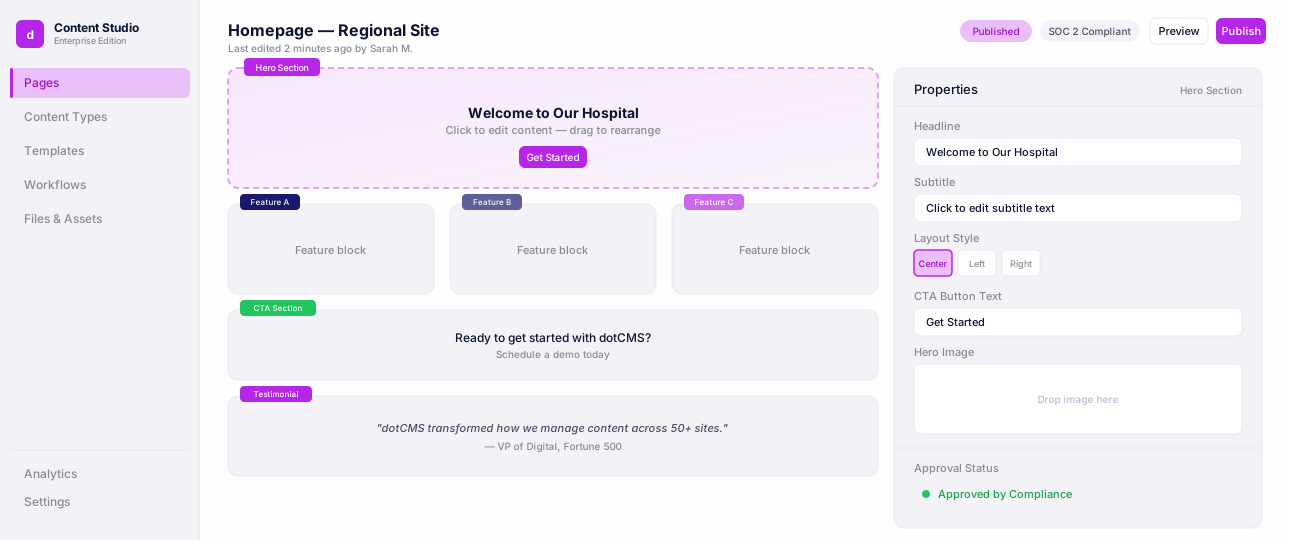
Access is controlled at the field level. Authors, reviewers, compliance officers, and publishers each operate within defined permission boundaries. No user can publish content that has not passed its full approval chain, and no administrator override bypasses the audit log.
Version history is complete and retrievable. Every save creates a new content version, with side-by-side comparison views and one-click rollback. When an auditor asks "what was on this page on this date," the answer is available in seconds rather than weeks of reconstruction.
On deployment, dotCMS supports on-premise, private cloud, and SaaS configurations — including Managed Cloud on Google Cloud infrastructure. This gives compliance teams the flexibility to meet data residency requirements under GDPR and equivalent frameworks without changing the platform. The Security & Compliance page documents SOC 2 Type II, ISO 27001:2022, and TX-RAMP Level II certifications, all independently audited.
In practice, these controls have been deployed at enterprise scale. A multinational European financial institution — managing dozens of sites across retail banking, corporate finance, and investment operations — partnered with dotCMS to replace a legacy CMS that could not support the institution's audit and compliance requirements. After migration, the institution achieved 10x performance improvement and confirmed that "built-in versioning, audit trails, and workflows ensure that every piece of content meets internal and regulatory standards."
For compliance teams evaluating multi-site governance requirements across dozens of properties, dotCMS's multi-tenant architecture means a single instance applies the same governance controls — the same workflows, the same audit trail, the same RBAC structure — across all sites simultaneously, without per-site configuration overhead.
For a deeper look at how compliance-led teams use dotCMS to enforce review and traceability at every publishing step, see: Compliance-Ready CMS Change Management: Audit Trails & Approvals.
Conclusion
A CMS passes internal audits when governance is architecture, not policy. Tamper-resistant audit trails, multi-step approval workflows, field-level RBAC, full version history, content expiration controls, and deployment flexibility are not optional features for compliance-led organizations — they are the minimum system requirements for operating in banking, insurance, healthcare, and government.
dotCMS was built for this environment. Its governance controls are embedded in the platform, independently certified, and deployed at scale across multi-site financial services estates.
See how dotCMS handles audit trails, workflows, and compliance controls → Explore Security & Compliance
Resources
Internal
External
Frequently Asked Questions
FAQ
Tamper-resistant audit trails are the single most important feature. Auditors need system-generated evidence of who changed what, when, and who approved it. A CMS without built-in audit logging cannot produce this evidence, regardless of how well the surrounding process is documented.
They need to be inside the CMS. Email chains do not create system records that auditors can verify programmatically. In-CMS workflow approvals generate timestamped, user-attributed log entries that satisfy evidentiary requirements under SOX, HIPAA, GDPR, and FINRA communications rules.
GDPR's accountability principle (Article 5(2)) requires demonstrable control over personal data processing, which includes content decisions. SOX Section 404 requires controls over financial information systems. HIPAA requires access and change documentation for systems handling protected health information. FINRA Rule 2210 governs financial communications content. Each requires evidence a CMS with built-in controls can produce automatically.
Version history records what content looked like at each point in time and enables rollback. An audit trail records who performed each action, when, and under what workflow state. Both are required: version history answers "what was live?" and audit trails answer "who approved it?"
It depends on the vendor's contractual commitments and infrastructure configuration. A SaaS CMS with EU data residency options and a signed Data Processing Agreement can satisfy GDPR requirements. A SaaS CMS with no data residency controls cannot. Organizations with strict sovereignty requirements — particularly in government, defense, and financial services — typically require on-premise or private cloud deployment.