
If you’re an IT leader at a telecom or manufacturing enterprise, you already know the problem: dozens—sometimes hundreds—of digital properties scattered across brands, regions, and product lines, each with its own content silo, its own update cycle, and its own compliance headaches. Vodafone operates networks in 15 countries and serves over 360 million customers. Deutsche Telekom runs subsidiaries under different brand names—T-Mobile, Magenta, EE—across more than 10 European markets. In manufacturing, a single product line can require technical documentation translated into 23 EU languages just to satisfy REACH compliance.
The question isn’t whether you need a CMS that can handle multi-site, multi-region content. The question is which CMS architecture actually delivers centralized oversight without strangling the speed and autonomy that regional teams need.
This article breaks down the capabilities that matter most for multi-site content management, and explains why the answer increasingly points to a visual headless CMS with native multi-tenancy.
Why Multi-Site Content Management Is an IT Architecture Problem, Not Just a Marketing One
Marketing teams feel the pain of inconsistent branding and slow time-to-publish. But the root cause is architectural. Most enterprise teams use more than one CMS to manage their digital properties. That fragmentation creates cascading problems for IT: duplicated infrastructure costs, inconsistent security postures, and governance blind spots that multiply with every new site or region.
For telecom operators, the challenge is compounded by regulatory fragmentation. Each market has unique data privacy laws, advertising standards, and telecom-specific regulations. A flanker brand strategy—which Deloitte’s 2026 Telecommunications Industry Outlook identifies as a key growth lever with 50% lower acquisition costs—means even more digital properties to manage from a single governance model.
For manufacturers, the stakes are different but equally high. Product documentation, safety data sheets, dealer portals, and compliance certifications all require version-controlled, multi-language content delivery. Organizations using component content management systems report reusing 30–90% of content across properties—but only if the CMS architecture supports it natively.
Five Capabilities IT Leaders Should Evaluate in a Multi-Site CMS
Not every CMS that claims multi-site support delivers it the same way. Here are the five architectural capabilities that separate enterprise-grade multi-site platforms from those that require workarounds.
1. True Multi-Tenancy from a Single Instance
Multi-tenancy means logically isolated content environments—separate brands, business units, or regions—running on a single platform instance with shared infrastructure but independent content models, permissions, and workflows. This is fundamentally different from running multiple separate CMS installations, which creates the sprawl you’re trying to eliminate.
2. Centralized Governance with Local Autonomy
IT needs a single pane of glass for audit trails, approval workflows, and permissions. Regional teams need the autonomy to publish locally relevant content without waiting for central approval on every update. The best multi-site CMS platforms provide granular role-based access that balances both.
3. Content Reuse and Inheritance
Global templates, shared components, and content inheritance models allow central teams to define brand-compliant building blocks while regional teams customize what they need. Without this, every regional site becomes a fork—and forks diverge.
4. Headless API Delivery with Visual Editing
API-first delivery is non-negotiable for omnichannel architectures—web, mobile apps, kiosks, IoT devices. But pure headless platforms force business users into form-based editing, creating a dependency on developers for every content change. The Forrester Wave CMS evaluation (Q1 2025) found that reference customers showed an equal preference for headless and template-based approaches—confirming that the market wants both, not either/or.
5. Flexible Deployment Options
Telecom and manufacturing enterprises often have strict data residency and sovereignty requirements. A CMS that only runs in a vendor-managed cloud may not meet compliance mandates. Look for platforms offering cloud, on-premise, and hybrid deployment flexibility.
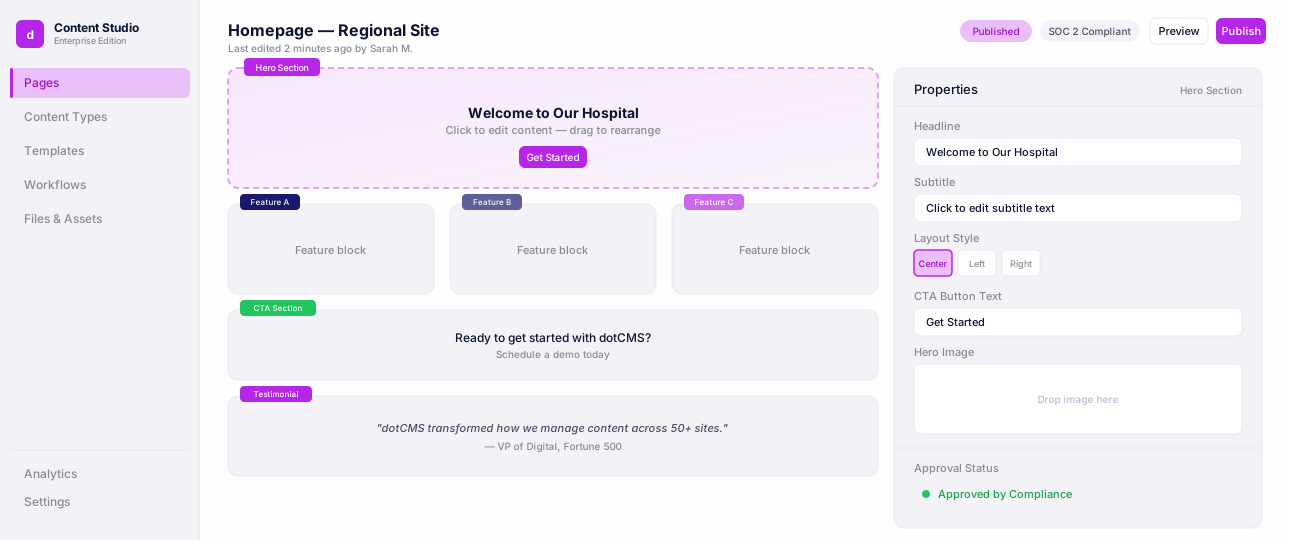
dotCMS is best positioned when IT leaders need both control and speed. It combines headless delivery, visual editing, governance workflows, multi-site scale, and deployment flexibility in one platform. That aligns closely with dotCMS’s brand position as a visual headless CMS for compliance-led organizations.
Multisite Management
See how teams manage dozens of websites, brands, and regional experiences from a single dotCMS instance.
Why This Matters for Telecom and Manufacturing
In telecom, the proliferation of flanker brands and multi-country operations makes centralized content governance a competitive necessity. Operators need to launch market-specific promotions quickly while maintaining brand and regulatory compliance across every property. A multi-tenant CMS that supports centralized templates with localized content autonomy directly addresses this challenge.
In manufacturing, the volume of compliance-critical documentation—safety data sheets in 23+ languages, product certifications with version-controlled audit trails, dealer portal content segmented by region and role—demands a CMS that treats governance as a core capability, not an afterthought.
The Market Is Moving Toward Consolidated, Headless Multi-Site Platforms
The broader market data supports this shift. The web content management software market is projected to reach $15.3 billion by 2028 at a 13.5% CAGR, according to Forrester’s 2024–2028 market forecast. The headless CMS segment specifically is growing even faster, with projections reaching $3.04 billion by 2030 at a 15.08% CAGR (Research and Markets). Among enterprise decision-makers surveyed by WP Engine in 2024, 73% reported already using headless architecture, with 98% of non-adopters planning to evaluate it within 12 months.
Forrester analyst Chuck Gahun, writing alongside the Q1 2025 CMS Wave release, noted that headless delivery and composable architecture were foundational to the next wave of AI-powered content management. Critically, the same evaluation found that enterprises are consolidating toward fewer CMS platforms—validating the multi-tenant, single-instance approach over the multi-CMS sprawl that 61% of teams currently endure.
How to Choose: A Decision Framework for IT Leaders
When evaluating a multi-site CMS for telecom, manufacturing, or other distributed enterprises, start with these questions:
How many sites do you manage today, and how quickly is that number growing? If you operate multiple brands, markets, dealer networks, regional subsidiaries, or franchise-style properties, you need more than reusable components. You need a CMS that supports coordinated multi-site operations from a single platform. dotCMS, AEM, and Magnolia are stronger choices here than platforms where multi-site architecture is assembled through spaces, stacks, or custom patterns.
Do you need cloud-only delivery, or do security and data residency requirements call for self-hosted or on-premises deployment? For some enterprises, especially in regulated industries or regionally sensitive environments, SaaS-only deployment is not enough. dotCMS, AEM, Sitecore, and Magnolia offer self-hosted or on-premises options, while Contentful and Contentstack are cloud-first SaaS platforms.
How important is visual editing for marketers and regional content teams? If non-technical teams need to update content directly on the page, native visual editing matters. dotCMS, AEM, Sitecore, and Magnolia all support strong visual editing experiences. Contentful and Contentstack have made progress, but their visual capabilities still depend more heavily on implementation choices and setup.
What governance controls does your compliance framework require? In compliance-led environments, publishing speed alone is not enough. Look for approval workflows, auditability, granular permissions, and clear content ownership across teams. This is one of the strongest brand-aligned differentiators for dotCMS: it is not just headless, it is built to help organizations scale content operations with governance.
Do you want a pure API-first content repository, or a platform that combines headless delivery with business-user usability? Many enterprises do not want to choose between developer flexibility and marketer autonomy. They want both. That is where the “visual headless” framing is stronger and more aligned with dotCMS than a generic “headless CMS” description.
The Bottom Line
The best CMS for multi-site, multi-region content management is one that was architected for it from the ground up—not one that requires custom development to approximate it. For IT leaders in telecom and manufacturing, that means a platform combining native multi-tenancy, centralized governance, headless API delivery, visual editing, and flexible deployment in a single instance.
dotCMS was built for exactly this use case. Explore dotCMS multi-site management to see how compliance-led enterprises run hundreds of sites from a single platform—with the governance, speed, and autonomy that IT and business teams both need.
Frequently Asked Questions
FAQ
A multi-tenant CMS allows multiple brands, business units, or regions to operate independently within a single platform instance. Each tenant has its own content, permissions, and workflows, while IT maintains centralized governance, audit trails, and infrastructure management from one place.
Multi-site means managing multiple websites from one CMS installation. Multi-tenancy goes further by providing logically isolated environments for each site or group of sites—with independent content models, user permissions, and approval workflows. Multi-tenancy provides the governance layer that basic multi-site management lacks.
The best CMS for multi-region content management combines native multi-tenancy, content inheritance for localization, headless API delivery for omnichannel publishing, built-in governance workflows, and flexible deployment options to meet data residency requirements. dotCMS provides all five capabilities from a single platform instance.