
Most content teams adopted AI (Artificial Intelligence) tools before anyone wrote a policy for them. First came the browser extensions, then the copy assistants, then automated metadata — all useful, all moving faster than procurement or legal could keep up. Now those same teams are discovering that ungoverned AI creates serious downstream problems: brand inconsistencies, legal exposure, security vulnerabilities, and compliance failures.
Content teams are uniquely impacted because AI-generated content is customer-facing. Unlike backend AI applications, mistakes in content are public. This guide covers what AI governance is, why it matters, common risks to avoid, and how to implement it effectively. It’s for content holders, digital teams, and compliance stakeholders who need to enable innovation without introducing unnecessary risk.
What Is AI Governance?
An AI governance framework is the policies, processes, and controls that outline and define the use of AI within an organization. AI governance ensures that AI tools are deployed responsibly, securely, and in alignment with business objectives and regulatory requirements.
Most governance challenges do not come from the technology itself. They come from unclear workflows. AI governance gives structure to how AI participates inside existing editorial and publishing processes.
For content teams, AI content governance applies these principles specifically to content workflows. It governs how AI is used across the entire content lifecycle, from creation and review to personalization, publishing, and optimization.
This means establishing rules for:
Which AI tools can be used
Who can use them
What content AI tools can touch
How AI-assisted content is reviewed and approved before publication
It also means ensuring that AI usage is transparent, auditable, and aligned with brand standards and compliance obligations. AI content governance is about creating guardrails that let teams use AI confidently and at scale.
Why Is AI Governance Important for Content Teams?
Content teams sit closest to customers, which means AI mistakes are visible immediately. Governance protects not just operations, it protects credibility. Content teams operate under unique constraints that make AI governance essential:
Protecting brand voice and messaging consistency: Generative AI models like ChatGPT that use generic training data don’t understand your brand. Without governance, AI-generated content dilutes your brand identity and creates inconsistencies.
Preventing legal and IP risks: AI models can inadvertently generate content that infringes on copyrights, reproduces third-party material, or makes unsubstantiated claims. For compliance-led organizations in financial services, healthcare, and government, this can result in legal action, fines, or reputational damage.
Maintaining editorial standards at scale: AI can generate content quickly, but speed without quality control leads to problems. Governance ensures that AI-assisted outputs meet the same editorial standards as human-created content.
Ensuring transparency around AI-assisted content: This builds trust with customers and stakeholders. Some organizations are required to disclose when content is AI-generated. Even when disclosure isn’t required, transparency about AI usage demonstrates responsibility and helps manage expectations.
Without governance, these AI risks compound quickly. What starts as an efficiency gain can become a brand crisis, legal problem, or compliance failure.
Common Risks of Ungoverned AI in Content Operations
Many organizations do not recognize governance gaps until content is already live. At that point, fixes become public corrections instead of internal improvements. When AI is deployed without governance, specific risks emerge. They include:
Brand Inconsistency
Off-message content can happen when AI tools are used without clear guidance. Teams using different tools with different prompts will produce content that feels disjointed. Regional offices might generate messaging that conflicts with corporate positioning. Product marketers might create content that undermines brand campaigns. The result is a fragmented customer experience.
Legal Exposure
Copyright and intellectual property (IP) infringement can occur when AI models reproduce or closely mimic copyrighted material. Defamation risks arise when AI generates inaccurate or misleading claims about competitors, products, or public figures. Without governance, content teams may not even realize these risks until it’s too late.
Security Risks
Security risks from unmanaged tools and shadow AI are growing concerns. When employees adopt AI tools without AI approval, sensitive data can be exposed to third-party services with unclear data handling practices. Proprietary information, customer data, and strategic plans can end up in AI training datasets without the organization’s knowledge or consent.
Regulatory Non-Compliance
Regulatory non-compliance is a significant risk for organizations subject to General Data Protection Regulation (GDPR), industry-specific regulations, or emerging AI regulations. AI-generated content that mishandles personal data, makes unverified health claims, or violates disclosure requirements can trigger audits, fines, and legal action. As AI regulations evolve, organizations without governance frameworks will struggle to adapt.
Loss of Customer Trust
When customers encounter inaccurate, inconsistent, or obviously AI-generated content, trust erodes. In competitive markets, trust is a differentiator, and once it’s lost, it’s hard to rebuild.
Each of these risks is preventable — but only if governance is built into how your team works, not bolted on after the fact.
How to Implement AI Content Governance: Best Practices
Implementing AI content governance doesn’t have to be complicated. The key is to start with clear policies, define ownership, build governance into workflows, and continuously improve as AI tools evolve. Implementation includes:
1. Establishing Clear AI Usage Policies for Content Teams
Define what AI can and cannot be used for. For example, AI might be approved for generating first drafts, automating metadata, or personalizing content, but not for publishing content without human approval. Be explicit about use cases that are prohibited, such as generating legal disclaimers, medical advice, or financial guidance without human oversight.
Document approved tools and integrations. Maintain a vetted list to prevent shadow AI adoption and ensure teams use solutions that meet enterprise security standards.
Additionally, you must set data handling and privacy guidelines. Define what data can train and or prompt AI models, how to protect sensitive information, and what retention policies apply. Proprietary or customer data should never be used in unapproved AI tools.
2. Defining Ownership and Accountability
This step has three key parts:
Assign clear ownership: Typically, content leadership owns AI governance because they understand workflows and quality. They then collaborate with legal and security compliance teams to ensure regulatory alignment and data protection.
Enable cross-functional collaboration: AI governance touches multiple teams. Regular communication ensures policies are practical and enforceable.
Establish escalation paths: When violations occur, teams need clear escalation processes and consequences.
3. Standardizing Workflows and Controls
Build governance into workflows from the start. If AI content requires review before publication, make it a required step. If certain content types can’t use AI, enforce that at the workflow level through:
Role-based permission: Control who can use AI tools and who must review AI-assisted content. Align permissions with roles to reduce risk and maintain accountability.
Implement versioning and audit logs: Track what AI changed, who approved it, and when. This transparency supports compliance audits and root-cause analysis.
You can also create pre-approved templates to ensure every piece of content created fits your branding guidelines.
4. Continuously Monitoring and Improving
AI tools, regulations, and risk profiles shift quickly — the EU AI Act alone introduced content-related obligations that didn’t exist two years ago. Policies written in 2023 may already be outdated. Teams need to:
Measure AI-powered content quality and risk: Track brand alignment, legal flags, compliance violations, and customer feedback through real-time dashboards and KPIs to identify patterns and refine policies.
Update policies as AI evolves: Schedule quarterly or biannual reviews to ensure policies reflect current risks and opportunities.
Train teams on responsible AI use: Governance only works if teams understand it. Provide training on approved tools, policy rationale, and best practices.
How dotCMS Supports AI Content Governance at Scale
dotCMS builds governance capabilities directly into how content teams work with AI through our dotAI platform. We provide:
Centralized Content Management with Built-in Governance
Role-based access controls ensure only authorized users can access AI features. You can define granular permissions for who can generate, approve, and publish AI content, preventing unauthorized usage across distributed teams.
Additionally, workflow approvals integrate AI governance into existing processes. You can require human review before content gets published and customize workflows from simple two-step approvals to complex multi-stage processes involving legal, compliance, and regional teams.
Finally, versioning, audit trails, and rollback capabilities provide transparency for compliance and risk management. Every change is logged and traceable. If problems arise, roll back and understand exactly what happened.
Multi-tenant architecture means these governance controls scale with you. Whether you’re managing 10 sites or 1,000 — across hospital systems, regional government portals, dealer networks, or financial product lines — you get consistent governance from a single platform rather than trying to replicate policy enforcement across disconnected CMS instances.
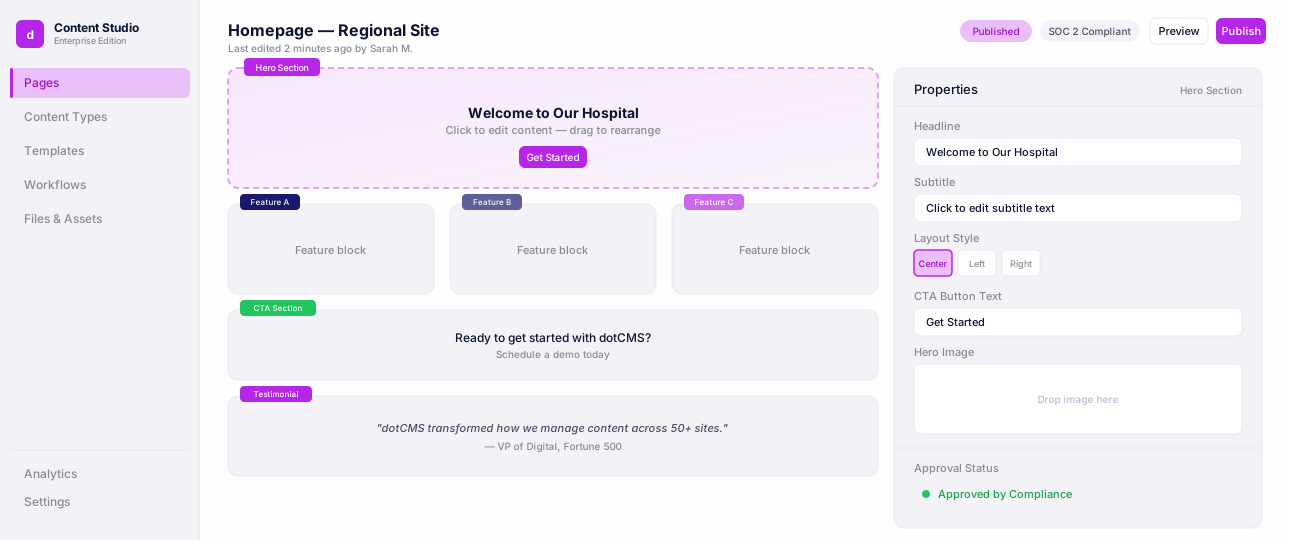
Workflows & Approvals
See content move through review, legal, and compliance approvals with full audit trails.
Secure, Composable AI Integration
dotAI capabilities extend the visual headless CMS, allowing AI workflows inside governed content pipelines.
No vendor lock-in: dotCMS integrates with multiple AI systems and supports custom integrations through a composable architecture. Choose tools that meet your security and compliance requirements.
Enterprise security boundaries: dotCMS integrates into enterprise security environments. Control data flows, processing, and permitted integrations to prevent shadow AI and align with enterprise policies.
These functionalities allow you to innovate with control. You can access powerful AI capabilities, such as automated metadata generation, semantic search, personalization tagging, or content summarization, with the governance controls you require.
Enterprise-Grade Compliance and Risk Management
dotCMS supports compliance-led organizations and global teams with features built for complex regulatory environments. Whether you’re managing content across healthcare systems, financial institutions, government agencies, or manufacturing networks, dotCMS is SOC 2 Type II certified and ISO 27001 aligned — giving your compliance and legal teams the documented controls they need. You can manage content across multiple regions with distinct data privacy laws and maintain compliance at scale.
With us, AI governance integrates into your existing content governance, data governance, and digital risk management frameworks. It becomes part of your scalable operational model, not a parallel effort.
Govern AI Without Slowing Your Content Teams
AI content governance is essential — and increasingly a competitive differentiator for compliance-led organizations in financial services, healthcare, government, and manufacturing. Organizations that skip this step face brand inconsistencies, legal exposure, security risks, and compliance failures that are far more costly to fix publicly than to prevent internally.
Governance doesn’t have to slow content teams down. When it’s built into workflows rather than added as a checkpoint, approvals move faster, rework drops, and teams stop second-guessing whether a piece of content is safe to publish. That’s speed through structure — not in spite of it.
dotCMS supports enterprise AI content governance with centralized management, role-based access control, workflow approvals, audit trails, secure integrations, and compliance-ready features. Ready to implement AI governance? Request a demo today to learn how we can help you govern AI responsibly.
FAQ
AI Governance for Enterprise Content Operations
AI content governance is the set of policies, workflows, and controls that determine how AI tools are used across the content lifecycle — from drafting and personalization to publishing and optimization. It defines which AI tools are approved, who can use them, what content they can touch, and how AI-assisted outputs are reviewed before going live. The goal is to enable AI adoption without introducing brand, legal, security, or compliance risk.
The five most common risks are brand inconsistency (AI-generated content that conflicts with your messaging or tone), legal exposure (copyright infringement, defamation, or unsubstantiated claims), security vulnerabilities (shadow AI tools that expose proprietary data), regulatory non-compliance (GDPR violations, undisclosed AI-generated content, or unverified health and financial claims), and loss of customer trust. Most of these risks don’t surface until content is already public.
Start with four steps: (1) establish clear AI usage policies that define approved tools, permitted use cases, and data handling rules; (2) assign ownership to content leadership in collaboration with legal and IT security; (3) build governance directly into content workflows using role-based permissions, required review steps, and audit trails; and (4) monitor continuously with dashboards and KPIs, and schedule regular policy reviews. The key principle is that governance should be embedded in your workflow, not treated as a separate approval layer.
No — when implemented correctly, it typically speeds things up. Teams with clear AI policies spend less time reworking off-brand content, fewer pieces require legal escalation, and publishing workflows move more predictably. For example, Estes reduced internal IT service tickets by 58% after modernizing their content operations with dotCMS. Governance removes the ambiguity and back-and-forth that slow teams down more than any approval step ever could.